CityWallet: The AI That Knows You Need a Coffee Before You Do
The Problem
The Problem
A café has three empty tables and fresh batches of coffee sitting in the pot cooling off. At the same time, eighty meters away, there's a person out in the city, feeling cold, with a phone in their hands. Neither knows about the other.
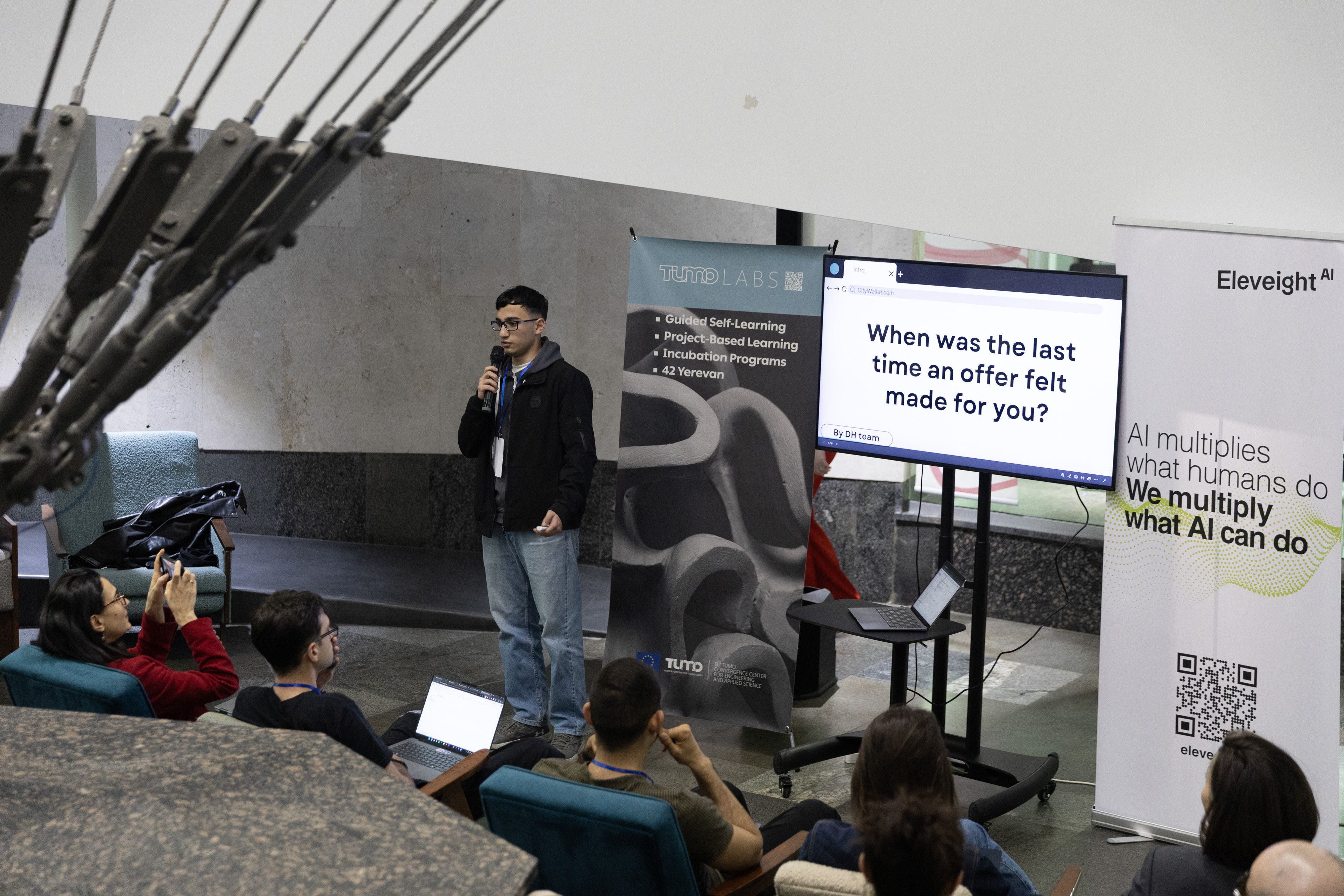
This was the problem that 17-year-old Daniel Hakobyan, from Vanadzor, Armenia, solved in 24 hours, alone. And won first prize at Hack-Nation’s Global AI Hackathon against competing teams backed by the top universities in Europe and elsewhere. The name of the project is CityWallet. Let's take a look at how it works.
The Solution
You see, your phone is constantly collecting data about its surroundings. Speed of movement, whether it's windy or chilly, battery percentage, departure from home by tracking the transition from Wi-Fi to cellular data, music festivals around the corner using open source data.
Almost no apps use any of this information, but CityWallet does.
It's running in the background on your device, processing the current situation and classifying it not geographically, but by states: for example, "walking slowly," "cold," "low battery level." It never needs to know any geographic data, although users can voluntarily opt-in to make the app work just that much better. It assumes how the user feels and knows what the environment is like, so that information is the only thing sent to the cloud.
The Offer That Generates Itself
Once CityWallet knows everything there is to know about your surroundings and yourself, it does something a regular discount application will not: it completely ignores any preferences the user has stated previously, and focuses on what they actually purchase.
Analyzing the user's purchasing behavior during 30 days, it constructs an invisible picture of the consumer profile. A user, who never selected the checkbox marked "coffee" at the beginning of the registration procedure, but purchases one every Monday, Wednesday and Friday at 8:20 am is considered as a person buying coffee anyway.
Now, with all this in mind, including behavioral and contextual states, it asks the AI to generate an offer, completely from scratch: it will be as if somebody has composed it specifically for this person right now, taking into consideration everything known about them. It will be hyperspecific and personalized, rather than copied from some database: here's what we have:
"Warm up and charge at Café Müller - 15% off"
"Escape the festival crowd - quiet café 300m away"
The offer includes the headline, the discount, and even the color palette depending on the user's current mood.
But It’s Not Just The Customer That Benefits
The beauty of the system is not just in helping the consumer in making decisions.
In the meantime, the café owner with 3 empty tables at 3:00pm may want to switch to the reverse process: instead of waiting, the merchant can start a search and ask the AI, searching for all potential consumers at once, to identify the three people who would be most likely to visit their shop at that precise moment, based on the previous behavioral profile of those people and the current environment surrounding the business. The AI will identify three potential clients and inform them through personalized notifications.
With this, both sides will benefit from the exchange: the café gains an extra table occupied by a new customer, and the customer receives a discount that fits them best. The discount will not be delivered via paper voucher or loyalty points; instead, it will appear right in the person's bank account.
Why DSV Chose This Project
The financial services provider DSV-Gruppe, which sponsored this competition, already possesses a huge asset: Payone, one of the biggest payment processors of Europe, and has a deep-rooted partnership with Sparkassen, a nation-wide network of regional German banks. What it doesn't possess is the intelligent layer, which would combine all the above to become usable for every customer.
What it gets now is CityWallet, which does not require any changes to the infrastructure possessed by DSV. All it needs is to connect everything together and add artificial intelligence on top of it. The deployment starts in Stuttgart today. Tomorrow, it can be in any city with a few simple configuration changes.
And that's why it won. Not because of its technical merits (though it is really impressive), but because it solves a real business problem using existing infrastructure, and it can be launched right away, wherever it is needed.
Final Thoughts
The code is accessible for everyone on GitHub. Daniel Hakobyan built this alone, during one night at TUMO Labs in Yerevan, while teams from MIT, Stanford, and other top-tier European universities were working on the same challenge.
Daniel is 17. This was his first international hackathon.
Judges from Meta, NVIDIA, AWS, Adobe, Microsoft, and Oxford looked at it and chose it.