NVIDIA GTC Berlin 2026: four AI infrastructure takeaways from Jensen Huang's keynote
Every region wants a seat in the AI economy, but a seat isn’t the same as a return. The real question is how a region’s resources, especially energy, turn into something businesses can actually use.
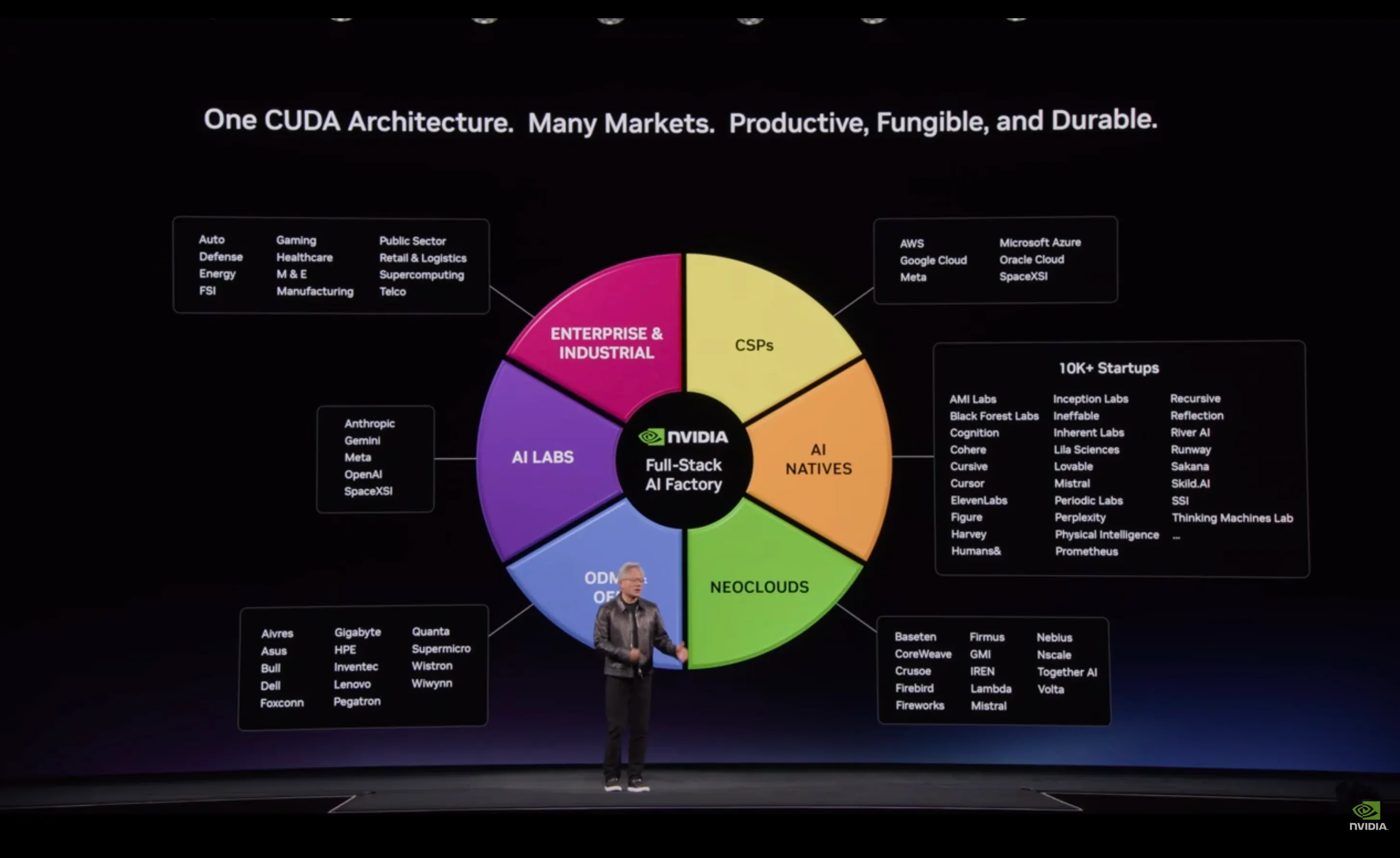
That was the thread running through Jensen Huang’s keynote at NVIDIA GTC Berlin. His message was simple: a region benefits from AI when its businesses put AI to work. That means discovering medicines, running smarter factories, building new services, and solving real problems in their fields, and doing it fast.
For AI infrastructure operators, that message is a job description. Available power has to become reliable compute that businesses and researchers can put to work, and an AI factory is judged by how well it does that. Power, cooling, system design, and deployment speed all shape the result.
As the operator of the first NVIDIA Blackwell Ultra-powered AI factory in Armenia and the South Caucasus, Eleveight AI shares four takeaways from GTC Berlin, and what they mean for the businesses and researchers who depend on AI infrastructure.
1. An AI factory works as one system
NVIDIA’s DSX platform treats compute, networking, storage, software, power, and cooling as one coordinated architecture. What counts is the performance of the whole AI factory.
For buyers, that changes how to evaluate infrastructure. GPUs need a steady flow of data. Distributed workloads depend on fast communication between systems. Power and cooling have to sustain the load around the clock. A weak link anywhere in that chain caps what an application actually gets. That is why infrastructure decisions should start from the workload's needs, with GPU specs as one input among many.
2. “Fast deployment” should mean fast to useful work
The headline announcement was DSX POD, a new NVIDIA reference design that turns a complete Vera Rubin AI factory into a repeatable, manufactured unit. Work that traditionally happens onsite moves to the manufacturing facility instead: compute and networking integration, rack-to-rack cabling, rack-level power, liquid-cooling piping, and functional validation. Each container arrives fully integrated and tested, ready to connect to the site’s power, cooling, and network infrastructure. Because site preparation runs in parallel with manufacturing, NVIDIA says deployment at a prepared site drops from around six months to as little as 14 days. A global partner ecosystem plans to begin deliveries in early 2027.
The time savings come from what no longer has to happen onsite. Traditional builds involve long planning cycles, specialized crews, and complicated logistics. A single late component or wiring mistake can push the whole schedule back. Building and testing in a controlled factory environment takes most of those risks off the table.
NVIDIA frames the payoff as time to first token: the moment a new AI factory starts serving production workloads. As Huang put it, “An AI factory creates value when it starts producing tokens, not when construction is complete.”
That is the right measure, and it is worth taking one step further: for customers, the first token that matters is their own. Moving data, configuring environments, and validating performance all come after the hardware is live, and that’s the timeline customers actually feel.
What goes inside those containers also shows how far the hardware has moved. The new Vera Rubin system is fully liquid-cooled and cable-free inside, and NVLink ties 72 GPUs together so they act like one giant GPU. Spectrum-X with co-packaged optics builds networking directly onto the chip, so data moves between systems faster and with less power. Every new generation packs more compute into each rack, which means more heat, more power density, and more data moving between machines. That’s why “prepared site” matters: power, cooling, and connectivity still have to be ready before those 14 days start.
For anyone buying compute, this changes what to look for in a provider. The facility needs a cooling path that scales as rack density rises. The networking has to be built for workloads spread across many GPUs, not just single servers. And the setup should follow NVIDIA’s reference designs closely, so jobs run without custom tweaks. That is how our own AI factory is built: to NVIDIA Reference Architecture, so workloads run as written.
3. Efficiency only matters when it’s tied to real output
On stage, Huang said DSX MaxLPS, NVIDIA’s dynamic power-allocation system, can cut power use by up to 30% for the same output. That links energy management directly to what the factory produces.
But a savings figure only means something when the output behind it is defined. A fair comparison needs consistent conditions. For inference, that means the same model, precision, input and output lengths, and acceptable response times. For training, it means the time and energy needed to reach a defined result. A strong efficiency claim should state which workload was measured, what performance target it hit, and whether energy was counted at the GPU, server, or facility level.
At the facility level, the standard metric is Power Usage Effectiveness (PUE). Eleveight AI’s facility runs at a PUE of 1.1: for every 1 kWh used by the IT equipment (the GPU servers, storage, and networking), only about 0.1 kWh more goes to cooling, power distribution, and other facility systems.
4. The best cooling uses no water
Huang also put water on the agenda. He described closed-loop liquid cooling paired with outdoor dry coolers, which release heat into the air without evaporating water. He said that at gigawatt scale, this approach can save tens of millions of liters of water a day, though it works best in suitable climates.
Eleveight AI’s NVIDIA Blackwell Ultra-powered AI factory was designed around zero water consumption for cooling. The facility uses 100% air cooling at the server-rack level: fans circulate air through the servers, carrying heat away from the chips. At high altitude, the outside air is cold enough to cool the facility on its own for most of the year, an approach the industry calls free cooling. For future higher-density workloads that require chip-level liquid cooling, the design calls for a fully closed-loop system with a dielectric coolant. The result is a Water Usage Effectiveness (WUE) of effectively 0 L/kWh.
What this means for teams building on AI
Every announcement at GTC Berlin pointed the same way: AI infrastructure is judged by how quickly and efficiently it turns power into useful work. That is the standard we hold ourselves to. If you are planning your next training or inference workloads, talk to our team.