It's a fair concern, and the track record and the global trends are the reason.
Eleveight AI's first AI Factory, in Gagarin, Armenia, is cooled with zero water. No water in the chips, No water in our cooling towers, No water drawn from Lake Sevan, from any Armenian river, or from any municipal drinking-water supply. We built it this way on purpose, and this is not a feature we added later. It is the foundational engineering principle the entire facility was designed around, from its very first day.
The numbers hold it up. Our Water Usage Effectiveness (WUE) is effectively 0 L/kWh. Our Power Usage Effectiveness (PUE) is 1.1, placing the facility among the most efficient AI data centers in the world. Across current and every future phases, water will never be part of our cooling system. This is a clear and unchanging commitment, which is locked into every engineering and expansion decision we make.
The wider conversation about data centers and water
Globally, data center water consumption is a legitimate and growing public concern.
Roughly 75 to 90% of large data centers worldwide use water-based cooling as their primary heat removal method. Approximately 57% of the water data centers use directly comes from drinking-water sources.
This is the global reality of how most digital infrastructure is cooled today. Eleveight AI has taken a fundamentally different approach.
What "water" really means in cooling: the distinction most people miss
There is a critical distinction that gets lost in the public conversation: not all "liquid" in a data center is water, and not all "water" in a data center is the same thing. Some systems use municipal drinking water that ends up evaporated into the atmosphere. Others use a synthetic, engineered fluid that never touches a tap, never evaporates, and never enters a natural waterway. These are completely different categories with completely different environmental implications, and confusing them is exactly what fuels public anxiety.
Every data center "uses water" in some sense, but “what kind of water” is the real question. Here is how to tell:
| Cooling method | What removes the heat | Drinking water used? | Used by Eleveight AI? |
|---|---|---|---|
| Air cooling | Ambient air pushed across the chips by fans | No | Yes |
| Free-cooling | Cold outdoor air, no mechanical refrigeration | No | Yes |
| Evaporative cooling (cooling towers) | Water sprayed and evaporated to the atmosphere | Yes — usually municipal drinking water | No |
| Adiabatic cooling | Water mist combined with airflow | Yes — often municipal water | No |
| Direct-to-chip water cooling | Water circulated directly over the chips | Yes — varies by facility | No |
| Direct-to-chip dielectric cooling | Synthetic, non-conductive liquid (not water) | No | No |
| Immersion cooling | Servers submerged in synthetic, non-conductive fluid (not water) | No | No |
The single biggest source of public confusion is the difference between direct-to-chip water cooling and direct-to-chip dielectric cooling. Both look alike from the outside: liquid moving through tubes and removing heat from processors. But they are not the same technology. Water cooling uses water, often drawn from municipal supply. Dielectric cooling uses a purpose-made synthetic fluid, one that is not water and is engineered specifically to conduct no electricity so it cannot damage the electronics. It circulates for years inside a sealed, hermetic loop, with no evaporation and no loss.
How Eleveight AI cools its AI Factory in Gagarin
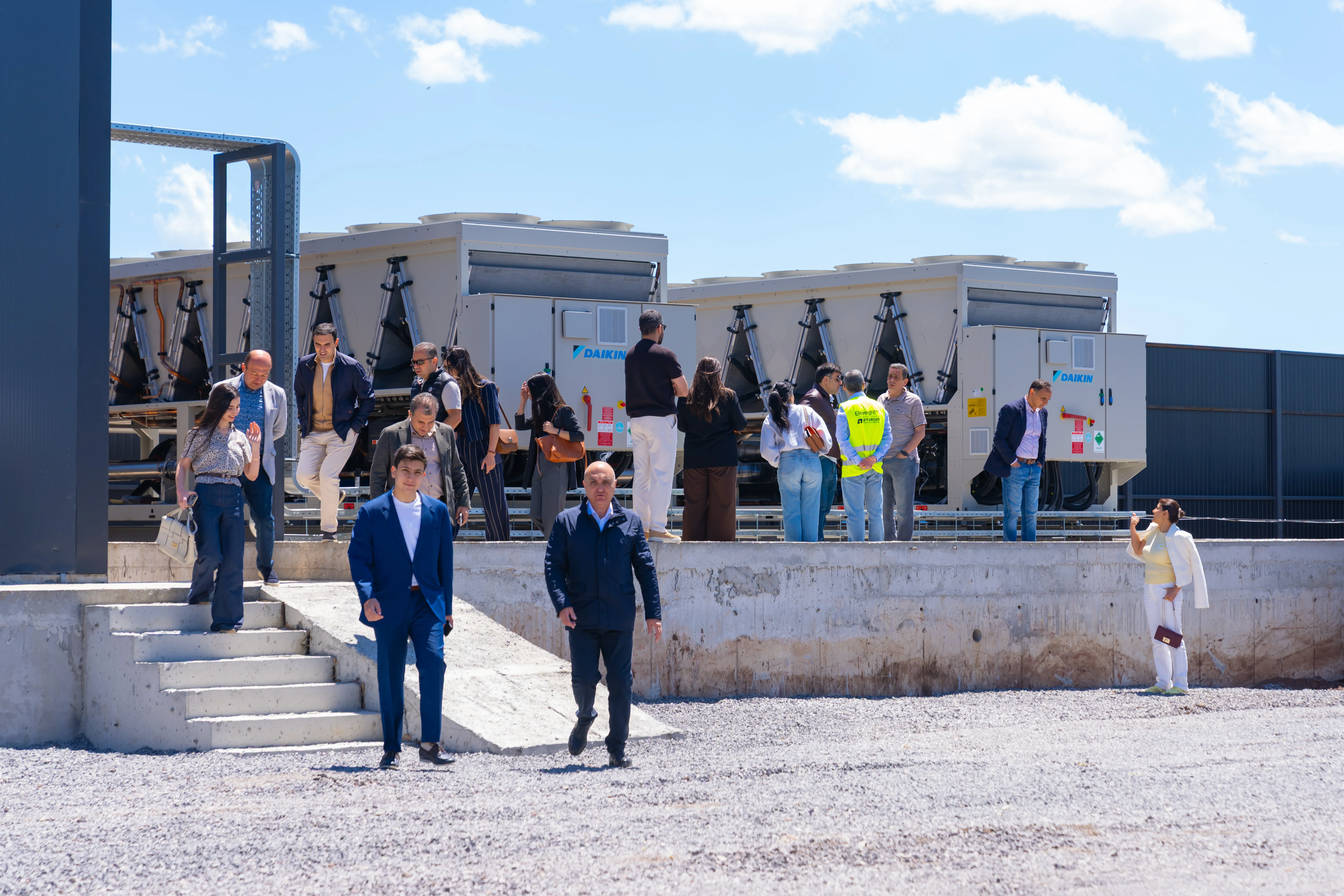
In the current phase the Gagarin facility uses 100% air cooling at the server-rack level. Fans circulate air through the servers, carrying heat away from the chips.
This works thanks to where we built it.
Gagarin sits at 1,886 meters above sea level in Armenia's Gegharkunik region, surrounded by natural wind corridors. The air here is cold and constantly moving. For roughly 11 months a year, the outside air is already cold enough to cool the facility on its own. The industry calls this free-cooling.
The result is the architecture summarized at the top of this article: PUE 1.1, WUE effectively 0 L/kWh, and zero water consumption throughout operation.
The locked principle: water will never be part of our cooling system
As Eleveight AI scales, we hold to one foundational principle: water will never become part of our cooling system.
When higher-density AI workloads eventually require liquid cooling at the chip level, we will use fully closed-circuit cooling with dielectric coolant, a hermetic, non-water synthetic fluid that is filled once and circulates for years.
This principle stays fixed in every strategic decision we make about how we grow, because the AI infrastructure that comes next has to be built in harmony with nature, without compromise.